
A Special Pre-Phase:
If you’re wondering why copywriting is important, just read this…
In 2012 Michael Dubin created a 1:33 video called “Our Blades Are F***ing Great” for just $4500.
He didn’t have a big team or fancy equipment, but forty-eight hours later, he had 12,000 new customers and a soon-to-be $1 billion exit.
How?
Copywriting, of course!
So, in this article, I’m going to give you a crash course on:
And a secret note at the bottom that you won’t want to miss, but for now let’s move on to…
Your Crash Course For Everything Copywriting
What is Copywriting?
Well, you’re reading it right now.
Copywriting is the art of writing words (called copy) in advertising, marketing, and sales to persuade your or someone else’s audience into taking an action.
In short: It’s sales in text.
Now, this doesn’t mean every piece of copy is closing the sale. In fact, most copy doesn’t “sell” in the way you’d think.
And I know that sounds like the opposite of what I just said, but you’ll realize it’s not once you see…
The Different Types of Copy
In the world of copywriting, there are three main types of copy. The first is…
Direct response
This is what most people think of when their mind goes to copywriting.
And for a good reason—it’s meant to get a direct response (usually a sale/sign-up.)
That also means when using this type of copy, you’re probably hard-selling prospects on a product/service.
Examples would be sales emails, sales pages, or anything aimed at selling.
But how do you get prospects ready to buy beforehand?
Brand copy
Again, this one’s in the name—it’s copy targeted at curating a brand’s identity, voice, and personality.
Building trust, educating people, and increasing likeability are all pillars of brand copy.
Hold on, how is sales in text?
Because the best salesmen don’t just sell a product, they sell themselves first. That’s exactly what brand copy is for.
Examples for this are endless, but you’ve probably seen Nike’s “just do it” or even our own about us page.
Great, but how do we actually get leads to the copy we’re writing?
SEO copywriting
This one can quite literally build a business from the ground up.
SEO is aimed at tapping into Google’s search engine to get organic traffic flowing into your website.
Essentially, when someone looks something up, you’re aiming to be one of the first results.
And that’s only half the pie. Because it’s one thing getting people on your page and another getting them to actually read it.
So this is where the copywriting comes in—you’ve got to write in a way that keeps people’s eyes glued from top to bottom.
Think of SEO as a bridge between people searching and your brand.
Examples would be blogs, product descriptions, and almost any page on a good website.
Ok, now that you understand the types of copy, let’s take a look at…
Copywriting In Action
Besides the example you’re reading right now, there are so many good showcases of copy in the wild.
One piece that really shows how powerful brand copy can be was in 2018.
KFC was facing a huge chicken shortage in the UK—they had to shut down 600 stores for about a week… and people were not happy.
#KFCCrisis was top trending on social media, almost everyone was mad or in disbelief, and some people even called the police!
So what did KFC do?
Instead of putting out some generic apology hiding behind corporate gobbledygook, they were honest, funny, and a bit cheeky:
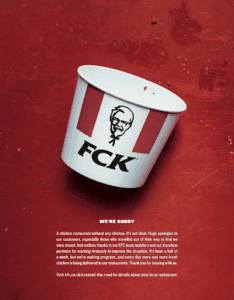
With this one ad, they turned national outrage into a connection and trust with their customers that’s lasted to this very day.
It’s an example of a unique way to use brand copy, but that’s not the only example…
In 2008 Obama’s digital team sent out hundreds of millions of fundraising emails. They rigorously A/B tested (50/50 split) thousands of subject lines.
Of course they tested ones you’d expect, like “Join us in building a movement,” but they also tested casual ones.
Soon enough millions were getting emails from Obama called “wow” or “I will be outspent.”
And in the end?
The subject line that got the most clicks was… “Hey.”
It goes to show that not every piece needs to follow the norm, and sometimes sticking out gets you the best results.
Now, if you want to see copy that blends everything together perfectly, you can have a look at our sales page (direct response), our about page (brand copy), and our tips & tricks (SEO copywriting).
All of these are live and working pieces of copy your eyes can feast on.
But what does “working” actually mean? Well, to answer that, we need to answer…
Why Copywriting So Important
It’s the backbone of marketing and almost every word your brand sends out.
To put things in perspective… You’ll need copywriting for ads, emails, landing pages, websites, apps, presentations, offers, social media, product packaging, posters, and the list goes on.
Now I know that’s a lot, but there are two clear things all of these have in common.
They sell, and they build a connection with your audience.
Sound familiar?
Yep, that’s exactly what a salesman does.
But you probably don’t want to hire 1 million of those—that’s exactly why copywriting is so important—one piece of copy can reach BILLIONS of people around the world.
Now, I’m not stupid.
You know how important copywriting is, and now your mind probably went straight to AI.
Sounds amazing—AI can write, and AI’s free. Why can’t you just use that?
Well, here’s the honest truth on…
Why AI Isn’t Good At Copywriting
First off, SEO is a definite no for AI.
According to Google, their search engine is able to detect whenever you’re using AI.
(And sorts that AI slop into the bad content pile—which basically means you won’t rank and defeats the whole purpose of SEO.)
Second, things aren’t looking much better for anything else.
There’s a saying that goes: “people buy from people” and it’s true.
Good copy feels like the words on the page are speaking to you—almost as if your grandma sent you a letter in the mail.
Maybe it’s not that exact tone, but you can tell someone sat down and wrote what you’re reading.
Now more than ever that feeling is so important, yet so rare.
Every brand and their mother sounds like the same boring company, not like an actual person.
But hey—if you somehow managed to get away with that, there’s still a huge problem staring you in the face:
AI doesn’t know how to do marketing.
Yeah, it can write… even make a plan that looks like it would work.
What it can’t do is write things that actually work. You see, copy isn’t just words—it’s the meaning behind them.
It’s how you frame the offer, it’s the angle, and it’s the timing.
Maybe AI can guess something together or copy someone else’s work, but it can’t feel what it’s like to be your audience.
Another thing AI can’t feel is what it’s like to break the rules.
That risky joke? The bold headline? Even a simple reference to something everyone knows but no one talks about?
Not possible (literally)…
After all, it’s coded not to and that’s what makes those examples I went over so good—they break all the rules, yet they get everything right.
Look, I think you get the point.
I could write a 300-page paper on why AI sucks, or I can just tell you this:
If you let AI do everything for you, you’re going to end up with a generic ball of what everyone else is doing.
(exactly what your audience doesn’t want to see again.)
But I think I know what you do want to see…
How Copywriting Can Increase Your Sales
Let’s start where everything begins—attention.
If you can’t get someone’s attention, they can’t buy from you. That’s why good copy doesn’t just hook readers, it keeps them mesmerized from start to finish.
But that’s not it, with good copy you’re also…
- Building emotion—People buy with emotions and justify with logic so instead of boring graphs or wordy emails, you’re talking to their heart
- Highlighting a problem—When you press on readers’ pain points, it warms them up to buy because people act fast when they’re uncomfortable (no, that’s not psycho, you’re just showing them they need a solution)
- And creating desire—This transforms a boring pile of features into mouthwatering benefits. So your audience wants your product more than their money
Alright, that all sounds good in practice, but what if they come up with some random excuse?
Don’t worry, we’ve got you covered.
Great copywriting reads your audience’s mind and closes their objections before they can even think of them.
This way they don’t have any reason not to buy.
But that’s not enough—some people have all the reasons in the world to purchase your perfect product, and they still won’t do it.
These fence-sitters are “too busy” or “still thinking it over,” but those aren’t options.
That’s why great copy uses urgency and scarcity to push them off that fence—so everyone with “all the time in the world” is suddenly left with 24 hours before that sale ends.
Which means immediate sales sent straight into your wallet.
The Final “Secret Note” (at the bottom):
Right, I’ve stuffed a lot into your brain, and some of it has probably fallen out, so let’s do a quick recap of everything we covered:
- Copywriting is sales in text but it’s not always closing the deal
- Direct response (hard sell), brand copy (building the brand), and SEO (google lead gen) are the three main types of copywriting
- Copywriting is the backbone of marketing and your sales
- AI isn’t good at copywriting because it’s not human and doesn’t know how to do marketing
And finally, copywriting is amazing at increasing sales.
Well actually, that last one has a caveat—good copywriting increases sales.
Meaning, (if you don’t want to do everything yourself) you’ll need a good copywriter. And that’s too bad…
Because at The Legacy Room our copywriters aren’t good—They’re f***ing great.
Which means if you’re looking for good enough sales or good enough copy, you’re not going to find it here.
But you’re looking for great copy and even greater sales…


 Boost open rates