
 James Kavanagh
Contents
- What you’re actually paying for (the genuine pros)
- The cons nobody puts on the sales page
- Who digital marketing courses are genuinely worth it for
- When to skip the course entirely
- How to tell a good course from a dressed-up playlist
- Are digital marketing courses worth it? Your questions answered
- The honest bottom line
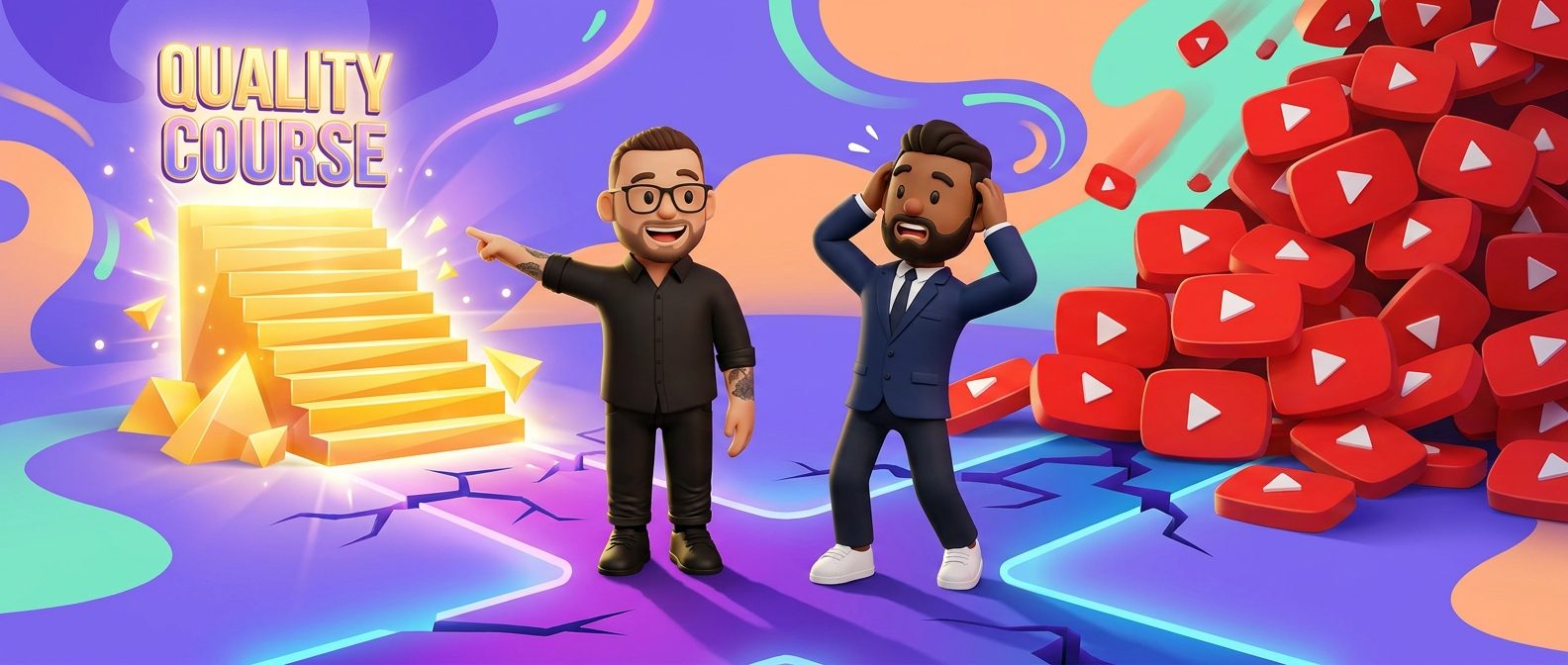
Are digital marketing courses worth it? It’s the question every sensible person asks right before handing over a few hundred quid — and the one most course sellers pray you won’t think about too hard. So here’s our honest verdict, no sales pitch stapled to it: sometimes a course is the best money you’ll spend all year, and sometimes it’s a YouTube playlist with an invoice attached. The whole game is telling those two apart before you pay, not after.
We’ll be straight with you. We run courses ourselves, so you’d expect us to scream “yes, buy everything, buy it twice”. We’re not going to. A bad course robs you of cash and confidence in one go, and that helps nobody. So let’s do the proper pros, the cons the landing pages hide, who should absolutely enrol, and who should keep their card firmly in their pocket.
Notice the word “good” doing a lot of heavy lifting there. The course itself is rarely the thing that changes your life; what you do with it afterwards is. A motivated person with a cheap-but-practical course and one real project will run rings around someone who’s bought four premium programmes and finished none of them. Buy the structure, then do the reps. That’s the whole secret, and nobody can sell it to you in a checkout.
What you’re actually paying for (the genuine pros)
Free content isn’t in short supply — there’s more of it than ever. What’s in short supply is order. A good course’s real product isn’t the videos; it’s the sequence. It takes a year of scattered tutorials and squashes them into a path you can follow without guessing what comes next.
- A path, not a pile. Foundations first, then channels, then the clever stuff — in an order that makes sense, with the dead ends already chopped out for you.
- Feedback. The one thing YouTube simply cannot give you. Someone telling you why your ad flopped is worth more than fifty videos telling you it might.
- A portfolio. Good courses make you produce real work — campaigns, copy, funnels — so you finish with proof, not just a certificate gathering digital dust.
- Current tactics. The field moves at a sprint. A decent course is rebuilt for what’s working now, not what worked back when everyone still trusted their inbox.
And the money is nothing to sniff at. UK digital marketers earn somewhere around £42,500 on average, with entry-level roles starting near £25,000–£30,000 and management nudging £60,000. The sector keeps growing — job openings are tipped to rise by roughly 10% through 2026 — and every solid technical skill you add can lift your earning power by another 5–8% when it’s time to talk money. Skills like GA4, attribution modelling, conversion-rate work and the new wave of AI tools are exactly what employers are short of right now. A course that drills those properly pays for itself fast.
The cons nobody puts on the sales page
Now the bit the slick landing pages skip right over.
- No guaranteed return. A certificate is not a job offer. Plenty of people finish a course and still have to graft hard for that first role or client.
- Out-of-date content. Some courses are still flogging 2022’s playbook with a straight face. In this game, that’s basically ancient history.
- Hidden costs. The sticker price is rarely the full price. Paid tools, exam fees and “advanced” modules can quietly double what you actually hand over.
- All theory, no doing. If there are no hands-on projects, you’re paying to watch telly. You learn marketing by doing marketing, not by nodding along to it.
If you want the full breakdown of where the money goes — and which price band is actually fair in 2026 — we’ve laid it all out in our guide to how much digital marketing courses cost in the UK. Read that before you pay a penny for anything.
Who digital marketing courses are genuinely worth it for
Be honest with yourself about which camp you’re sitting in.
- Career changers with no marketing background who need structure and a portfolio to wave at employers. For you, it’s a massive yes.
- Business owners sick of handing money to agencies and getting a shrug back. Learning the levers yourself pays off for years, not weeks.
- Freelancers who can do one thing well and want to charge for five. A focused course widens what you’re allowed to invoice for.
- Employed marketers who need one specific, in-demand skill — paid ads, SEO, automation — to argue for a rise or finally get that promotion.
When to skip the course entirely
Sometimes the honest answer is don’t bother. Genuinely. Keep your money if:
- You won’t do the work. No course survives contact with “I’ll start Monday”. If you already know you won’t finish, a course is just guilt with a login screen.
- You only need one platform’s basics. If you literally just want to run a Facebook ad, the free training from Google, HubSpot and Meta will get you there for nothing. They’re genuinely good at the platform-specific stuff — they’re just thin on strategy, joining it all together, and any kind of feedback.
- You’re already doing it well. If you’re getting results, you don’t need a beginner’s course. You need a specific advanced one, or a mentor — which is a completely different purchase.
There’s no shame in any of these. Sometimes the smartest marketing decision you’ll make all year is not spending.
How to tell a good course from a dressed-up playlist
Decided you’re in? Good. Here’s the quick sniff test. Walk away if you spot:
- Stale content. Anything built before roughly 2023 and not refreshed since. Ask outright when it was last updated — a good provider will tell you happily.
- No hands-on work. No projects, no briefs, no feedback, just a wall of videos. Hard pass.
- Fake urgency. “Only 3 spots left!” on a digital product that physically cannot run out. That’s a tell about how they sell, and how they teach.
- No proof. No outcomes, no real reviews, no examples of what past students actually built. If they had the results, they’d be shouting about them.
Want the longer version of this argument, with both sides properly weighed up? Our pillar piece on whether digital marketing courses are still relevant in 2026 goes deeper on where the whole category is heading and why structure still wins.
Are digital marketing courses worth it? Your questions answered
Are digital marketing courses worth it for getting a job?
They can be, but the certificate alone won’t do it. What gets you hired is the portfolio and the practical skills a good course makes you build along the way. Employers in 2026 want people who can actually run GA4, manage live campaigns and use AI tools — so choose a course that’s heavy on doing, not just watching, and treat the projects as your real CV.
Can I just learn digital marketing for free instead?
For platform basics, yes — Google, HubSpot and Meta all offer solid free training. The catch is they teach you the pieces, not how to join them up. Free routes cost you in time, missing feedback and zero structure, which is exactly the gap a good paid course fills. Free is brilliant for topping up one specific skill; far weaker if you’re starting from scratch and need a path.
How much should I pay for a digital marketing course in the UK?
It ranges from free to several thousand pounds, and pricier absolutely doesn’t mean better. Focus on what’s included — live feedback, real projects, genuinely up-to-date tactics — rather than the size of the price tag. We break down the fair UK price bands in our cost guide, linked higher up this page.
Will a digital marketing course make my money back?
Only if you use it. With UK marketing salaries sitting well above the national average and each new skill lifting your earning power, the maths can work surprisingly quickly — but a course is a tool, not a lottery ticket. The return comes from the work you put in afterwards, not the payment you make today.
Are free digital marketing certificates worth anything?
They’re worth a line on your CV and a bit of base knowledge — nothing more. No UK employer is hiring on a free badge alone. They’re a perfectly fine starting point, but they don’t replace proof that you can do the actual job.
The honest bottom line
So — are digital marketing courses worth it in 2026? Yes, if you pick a practical, current one and actually do the work. No, if you’re buying it mostly to feel productive. Spend on doing, not on watching, and you’ll rarely regret it.
That’s exactly the kind of course we build: practical, current, and allergic to fluff. Come and see what we teach at The Legacy Room and decide for yourself — no fake countdown timers, we promise.


 Boost open rates