 James Kavanagh
Contents
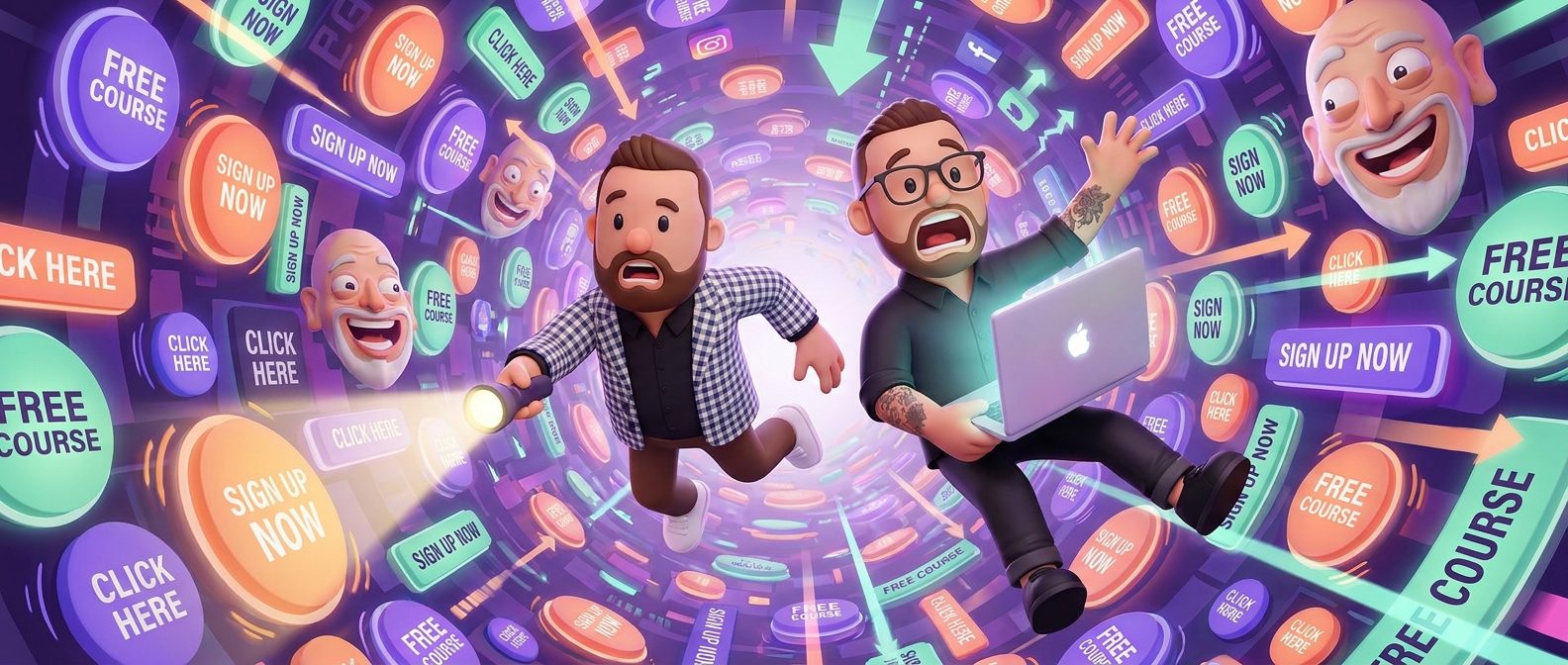
Search “how do I learn digital marketing” on Google and you fall straight into the same hole everyone else does. Four hundred free videos. Six “free” certificates. Or some guru swearing the internet’s hiding what actually works, and surprise, the only place to find it is his course.
An hour later you’ve learned nothing, and somehow you’re subscribed to three newsletters. (What’d you expect?)
If that’s how it goes every time you try, the problem isn’t you. There’s more marketing *content* online than ever, and almost none of it is sorted into an order a beginner can follow. So the basics have actually got harder to learn, not easier. That mess is the whole reason structured courses still earn their keep: they teach the doing, not the theory.
So let’s answer the real question honestly. In 2026, with AI writing half the internet and free certs on every corner, is a digital marketing course still worth your time and money?
Mostly yes. But only the right kind, and here’s how to tell the difference.
The key word is *structured*. You can learn every single thing in marketing for free, scattered across YouTube, blogs, and Google’s own training. The trouble is there’s no order to any of it.
You don’t know what to learn first, what’s outdated, or what you can safely skip. A proper course hands you the map so you stop guessing and get building.
The best ones don’t just explain. They make you do the work, on a real project, so you finish with skills you can prove instead of notes you’ll forget.
The Different Types of Digital Marketing Courses
“Digital marketing” is really a stack of separate skills, and most courses focus on one slice. Knowing the slices helps you pick.
SEO courses
These teach you how to get a site ranking on Google: keywords, on-page structure, content, and links. If you like the idea of writing things that pull in customers for years without paying for ads, start here. Our full guide to SEO courses in 2026 breaks down what they teach, what they cost, and how to pick a good one. One learner we came across was running a WordPress blog purely to practise SEO, which is exactly the right instinct. For a practical example, see how to write articles that rank on page one of Google.
Email marketing courses
Email is the channel that still makes the most money per send, and it’s badly taught almost everywhere. A good email course covers welcome sequences, broadcasts, and the writing that gets opened and clicked. It’s our home turf, so we’re biased, but pound for pound email still earns more than any other channel. Want the deep dive? Here’s our guide to choosing the right email course.
Paid ads (PPC) courses
Google Ads, Meta Ads, and the art of spending a pound to make three. Faster results than SEO, but you’re paying for every click, so the skill is in not setting money on fire.
Social media marketing courses
Writing hooks that stop the scroll, and turning the followers you win into actual customers instead of vanity likes. Social moves faster than any other channel, so a course here is only worth your time if it’s genuinely current.
Content and copywriting courses
The writing under all of it: ads, emails, pages, posts. Learn to write well and every other channel gets cheaper and easier. This is the skill that ages the slowest. Or browse our own content marketing courses to learn from people doing it daily.
Analytics and data courses
Learning to read what’s working so you stop guessing. Google Analytics, tracking, and the reports that tell you where the money came from. Less glamorous, and it’s the work that gets you promoted.
You don’t need all six on day one. Pick the one that sounds like work you’d happily do on a Sunday, go deep, then widen out. Our guide to the different types of digital marketing courses breaks down which to learn first depending on your goal.
Why You Still Need a Digital Marketing Course in 2026
The “just use AI” and “just watch YouTube” crowd have a point. So why pay for a course at all?
AI didn’t kill marketing skills, it raised the bar
AI can write a passable email in seconds, which means passable is now worthless. Everyone has the same tool producing the same beige copy.
What’s gone *up* in value is the human judgement to brief it properly and make it read like a person wrote it, not a robot. You only get that by learning the craft underneath, which is why it pays to know which marketing skills are durable and which are just this year’s fad before you commit your time to them. A course that teaches you to think, not just to prompt, is worth more now than it was in 2020.
The skills gap employers and clients actually pay for
The forums have this bit right: a certificate on its own won’t get you hired. Recruiters say it plainly. A Google cert looks good on a job application. Better than nothing, nowhere near as good as real-world experience.
So the certificate isn’t the prize. The prize is the skill and the portfolio you build earning it. Pick a course that produces real work you can show a client or an employer, and you’ve got the one thing a bare certificate never gives you: proof you can actually do the job.
Who Should Take a Digital Marketing Course?
Career starters and changers
If you’re coming from an unrelated degree or no degree at all, a course is the fastest honest way in. We’ve seen people pivot from psychology, biology, and engineering into marketing roles off the back of structured training plus a portfolio. The training gets you the language and the foundation. The portfolio gets you the interview.
Business owners and their teams
If you run the business, you don’t need to become a full-time marketer. You need enough to spot nonsense from agencies and to brief work properly, or to train a staff member to handle it in-house. If that is you, our rundown of the best internet marketing courses for entrepreneurs is the fastest way to work out where to start.
A focused course pays for itself the first time it saves you from a bad retainer. Plenty of owners send us their staff for exactly this, so you can train your team through us or learn it yourself.
How to Get Started (and What to Look For)
Before you hand over any money, run the course past these five checks. They’re the difference between a skill and a refund you’ll never bother chasing.
- Who actually teaches it? Have they run real campaigns with real money on the line, or do they just sell courses about running campaigns? Practitioners teach you what works. Professional course-sellers teach you what sells courses.
- Is it current? Marketing rots fast, so ask when the course was last updated. Anything that ignores AI in 2026 is already out of date.
- Do you actually do the work? You should finish with a real project, not a video count. You learn this by doing it, not by reading about it.
- Is there feedback? Someone who knows the craft telling you where your work falls down is worth more than ten more hours of video.
- Free or paid, what’s the honest difference? Free Google, HubSpot, and Meta courses are genuinely good for the basics. Whether a free certificate is enough or you need an accredited course is a judgement call, and you shouldn’t feel pushed to pay for ground you can cover for nothing. Pay when you want feedback and a real outcome the free stuff can’t give you.
Start free to confirm you enjoy the work. Pay once you’re serious and you want a path instead of a pile of tabs.
Frequently Asked Questions
Will a digital marketing certificate actually get me a job?
On its own, rarely. It shows an employer you’ll teach yourself, which counts for something at entry level. What gets you hired is the skill and the portfolio behind it. Choose a course that builds both.
Do marketing certificates expire?
Some platform certs (Google, Meta) do lapse and need renewing, which is fair enough since the platforms change. The skill doesn’t expire. Keep the work you produced and keep it current.
Do I need a degree to work in digital marketing?
No. A degree helps in some companies and is irrelevant in most. Demonstrable skill and a portfolio beat a marketing degree for the majority of roles, especially in agencies.
Is a course worth it if I’m a complete beginner with no marketing background?
Yes, as long as you pick one built for beginners and you bring patience. The point of a course as a beginner is to skip the year you’d otherwise waste working out what to learn first.
How long until I’m actually any good?
Weeks to grasp the basics, months of real practice to be hireable, and you’ll be learning forever after that. Anyone promising “expert in a weekend” hasn’t done the job.
Learn It From People Who Actually Do It
We’re practitioners first and teachers second, which is the whole point. Everything in our courses is the work we teach every week, the same work that’s generated over £10M and trained 140+ students so far. There’s no theory for its own sake, and no rented supercar in sight. Ready to learn from a team that does this for a living? Explore our marketing courses, or head back to The Legacy Room homepage to see how we work.
If you want the structured path instead of the rabbit hole, take a look at The Legacy Room’s marketing courses and start with the channel that sounds most like you.
Want to keep going? If you’re weighing it all up, start with whether digital marketing courses are actually worth it and how much they cost in the UK. Brand new? Here’s where beginners should start and what a good course really teaches you. Wondering how long it all takes to get good? Here’s how long it takes to learn digital marketing. Bothered about format? Weigh up online versus in-person, or see what to expect from digital marketing classes. Wondering about the payoff? See whether these courses actually get you a job, and gauge how long an internet marketing course takes before you commit. Chasing a formal credential? See which digital marketing qualifications are actually worth it. And for the wider picture, dig into our complete guides to online marketing courses and internet marketing courses. And if you’re starting from scratch, here’s how to learn digital marketing the sane way, or work out whether you can skip the classroom altogether with our honest look at how to teach yourself digital marketing. And once you’re ready to stop reading and start doing, here’s how to learn online marketing by doing.

 Boost open rates